

Milk Dispenser Business Plan on How To Pump Good Cash From A Milk Dispenser ATM
A milk ATM functions similarly to a typical bank ATM, with the exception that it accepts coins and dispensing milk (simply put). Although this is not a novel concept in Kenya, as numerous supermarkets currently provide it. With so many upcoming estates in our urban areas, as well as an abundance of raw milk from our diligent farmers, there is no reason why you should not profit from this opportunity. Let’s see how you get started with this milk dispenser business plan on how to pump good cash from a milk dispenser.
Milk dispenser business plan on how to pump good cash from a milk dispenser ATM
Step One: Locate a suitable location.
The key to success in this business is to make a significant number of sales per day. As a result, you should position your company in a densely populated location. The greater the number of walk-in consumers your ATM can attract, the better. But what if locating such a place is difficult? Not to worry.
You can negotiate a revenue sharing agreement with your local supermarket or mini-market. For example, one Rongai resident had teamed with Tuskys. They will provide you with the location, and you will provide them with the machine and milk to dispense. Isn’t that clever?
Step 2: Select a Reliable Milk ATM Machine
Choose a machine that is within your budget and has the capacity to meet your clients’ demands. Start small with a 200-litre machine and progress to a larger 1000-litre machine as demand grows.
You can acquire the machine locally from local producers such as Saset or import it directly from Italy. Locally produced machines are less expensive, and as you know, it is an excellent notion to BUY KENYA, BUILD KENYA.
Another advantage of buying locally is that it’s easier to get repair and maintenance.
It’s important to note also that locally sold milk ATMs meet KBD(Kenya Dairy Board) standards so you can be assured you will not get into trouble with them. Some imported ones can’t guarantee you that they meet these standards.
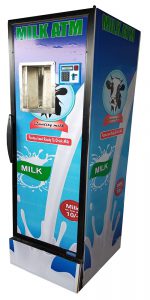 Here are some guidelines to help you buy a good milk ATM machine.
- As previously said, check it fits KDB approved.
- Get one with an integrated chiller. Milk is a perishable item that must be kept cool.
- If importing, consider purchasing the machine in pieces to be built locally. This will help you save money on taxes.
- In general, search for a machine that is simple to operate. Preferably one whose technology is understandable even by children.
- Look for a machine with readily available spare parts nearby, and insist on warranty coverage on all purchases.
Step Three: Make Milk Arrangements With Farmers and Suppliers
Yes, your firm will be located in urban areas, but in order to obtain excellent and consistent milk supplies, you will need to establish relationships with farmers or suppliers. Take the opportunity to tour the nearby rural areas and compare costs as part of your planning before selecting on the most viable supply.
Take no chances. Make your suppliers sign a contract with you so you know they won’t sell your milk to anyone else and leave you without supply.
Look for high-quality milk that has not been contaminated with water.
The Kenya Dairy Board only allows pasteurized milk to be sold. Look for farmers who can provide pasteurized milk rather than raw milk.
Don’t worry if you can’t locate pasteurised milk. You can buy cheap raw milk and invest in a pasteurizer. Excellent thought!
At the farms, a litre of raw milk costs 35/-, whereas a litre of pasteurised milk costs 50/-.
Fourth step: Obtain a License
You’ll need a licence from the Kenya Daily Board, which will set you back Ksh.2,500 plus a Ksh.600 application charge. This is in addition to the county single business permit, which can cost as little as Ksh.5,000 in isolated counties and as much as Ksh.20,000 in big counties such as Nairobi and Mombasa.
Hint: Areas that fall in Machakos, Kiambu or Kajiado counties tend to have cheaper single-business permit charges than ones in the core Nairobi despite their proximity to the city (Examples: Ongata Rongai (Kajiado), Syokimau (Machakos), Githurai 45 (Kiambu), Kahawa Sukari(Kiambu), Kahawa Wendani (Kiambu), Ruaka (Kiambu), Mlolongo (Machakos), Kitengela (Kajiado).
Milk dispenser business plan on how to pump good cash from a milk dispenser ATM
How Much To Spend As You Start (Estimates)
Buying Milk ATM (200 Litres) – 275,000
- Rent & Deposit – Ksh.20,000
- Pasteurised Milk – Ksh.55 per litre
- Transport – 1,000
- Relevant Licenses – Ksh,20,000
Minimum starting budget = Ksh 330,000
As your business grows, you can invest in a pasteurizer so that you can buy raw milk and pasteurize it yourself, saving you 20/-… This will allow you to increase your profit margins while remaining competitive. A good pasteurizer will set you back approximately Ksh 200,000.
You can also purchase a motorcycle, which you will use to collect milk from rural areas and carry it to your city business.
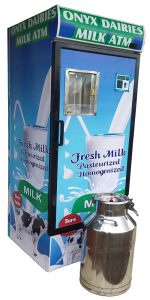 Profit Potential (Estimates)
A well-known milk ATM can sell more than 200 litres of milk every day. This is because ATM milk has the same quality as packaged milk but is 30% less expensive. So, as long as your business is clean and your customer service is excellent, there’s no reason why you shouldn’t sell more than 200 litres every day.
For the sake of math, let’s use 200 litres.
Monthly Sales = Ksh 420,000
Monthly Expenses = Ksh 255,000
Monthly profit estimate = Ksh 165,000 (Per ATM)
According to this rule, you will only need four months to return your initial investment.
Last Word
A litre of pasteurized and packaged milk costs Ksh 100/- in supermarkets, thus offering lower prices will give you a clear competitive edge. Remember, even without a pasteurizer, you may start small and still make a nice profit.
Alternatively, you can pay a little more and get a pasteurizer to add value to your milk and sell it at a profit. And because milk is such a basic product, you won’t have to compete for customers.