

Capsicum Farming Agribusiness Plan
If you conduct a simple Google search for the keywords “Capsicum Farming in Kenya” or “Pilipili hoho farming,” I am confident you will come across scores of articles lauding this agri-business as one of the best investments one can make. Some refer to it as a low-cost, high-yield investment. Others characterize it as one of the few agricultural products that has a ready market. But how reliable are these claims? Is capsicum farming as successful as it is described in blogs; is it a viable enterprise for a modest investor? Let’s see if this holds true in the capsicum farming agribusiness plan below.
Capsicum Farming Agribusiness Plan
Requirements for Farming Capsicum
There are two methods of growing capsicum. The first method involves open-air farming, whereas the second one involves greenhouses. Although it is more expensive to set up, the greenhouse alternative is more popular because it produces higher harvests and uses fewer pesticides and fungicides. On the other hand, open-air farming isn’t all that horrible either; it’s less expensive to set up and production can still be increased by making small adjustments here and there.
Open Ground Farming
 You will need fertile land in order to engage in open-air farming, ideally in a region with sufficient rainfall and moderate temperatures (20 – 25 degrees centigrade). These criteria are met across the majority of Central Kenya, the Central Rift Valley, Western Kenya, and Nairobi. You will then work the property. Before bringing the seeds to the farm, put some seeds in a nursery that you can access through the agrovet. To make sure that your farm is well-maintained and that productivity is maximized, you will need to have a steady supply of labor and water.
- Capsicum Seeds – 5Kg/Ha Cost:Ksh.2,000
- DAP Fertilizer – 25Kg Cost:Ksh.2,500
- NPK/CAN Fertilizer – 50Kg Cost:Ksh.4,000
- Manure Compost – Ksh.200 per Bag
- Pesticides and Fungicides – 5,000
- Water supply and drip irrigation – Ksh.30,000
- Labor and Others – Ksh10,000
Capsicum Farming Agribusiness Plan- recommended budget: Ksh 50,000
On less than a quarter acre of ground, this arrangement can produce 120 kilograms of healthy capsicum per week, or up to 800 kilograms throughout the full harvesting season.
Farming in a greenhouse
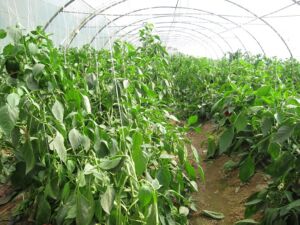 Greenhouse farming is praised for its advantages, notably in terms of boosting food quality and optimizing value per area. To employ this method, you will need to invest in a nice 8m x 15m greenhouse with drip irrigation lines. Amiran or other local contractors can help you order one. Your expenditure will look like this if you follow this formula:
- Capsicum Seeds – 5Kg/Ha Cost:Ksh2,000
- NPK/CAN Fertilizer – 50Kg Cost:Ksh.4,000
- Manure Compost – Ksh.200 per Bag
- Pesticides and Fungicides – 5,000
- Water storage and supply – Ksh.20,000
- Labor and Others – Ksh10,000
- Complete Greenhouse – 180,000
Capsicum Farming Agribusiness Plan- recommended budget: Ksh.230,000
A greenhouse will increase production, decrease water use, avoid the majority of common capsicum illnesses, and, most significantly, improve quality. A greenhouse-grown capsicum fruit is easy to identify and sells well both locally and abroad. A well-maintained greenhouse structure measuring 8 meters by 15 meters may produce 180 kilograms each week on average, or 1250 kilograms every harvesting season.
 Is Capsicum Farming Agribusiness A Profitable Venture in Kenya?
Like any other business, the success of a pepper farm depends on how well it is run. While a smaller greenhouse structure can yield Ksh.100,000 per season, a well-managed open farm (1/8 acre) can produce Ksh.64,000.
The key to success in this industry is making the most of the space that is at your disposal. For instance, you can earn roughly Ksh.200,000 per season if you build two greenhouses on a 1/8th acre site. As your investment increases and you look to take advantage of crop rotation, you can keep adding more greenhouses.
The size of your dreams will ultimately determine whether this firm is successful or unsuccessful. After the first year, you can expand up to a greenhouse from a modest open farm. The key, as with any other business, is to be patient.