

Sorghum Farming Agribusiness Plan
Sorghum farming can be a lucrative business venture for those who are willing to put in the required effort and dedication. One of the key factors to achieving high yields per area is the use of advanced farming techniques. These practices include proper soil preparation, timely planting, regular irrigation, and adequate pest and disease control. By implementing these methods, farmers can expect to obtain significant harvests and maximize their profits. This sorghum farming agribusiness plan will give more insights on the potential of this venture.
It is worth noting that sorghum farming is not a quick and easy way to get rich. It requires careful planning and management to achieve success. As with any agricultural activity, crop failure is always a possibility, and risks associated with factors such as weather, market prices, and crop diseases need to be taken into account.
Nevertheless, sorghum farming has the potential to yield considerable profits over the long term for those who are willing to invest the time, energy, and resources necessary to succeed. Farmers who are motivated, innovative, and willing to take calculated risks can achieve financial stability and a rewarding career in this field.
Sorghum Farming Agribusiness Plan- Why it’s a great agribusiness option for Kenyans
Sorghum is a grain crop that ranks second in importance only to maize, wheat, rice, and barley. Because of its marketability, it can be a one-of-a-kind investment opportunity. Most of Kenya’s regions benefit from the crop, particularly semi-arid areas like Mwingi and warmer areas like Siaya. Sorghum has a ready market and matures in four months. However, before considering it as an investment, it is critical to investigate its profitability. Here is an agribusiness plan for sorghum farming to help you evaluate its potential.
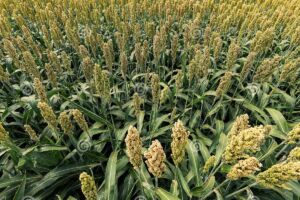 Most suitable conditions for sorghum production in Kenya
Kenya has the best conditions for sorghum production. Sorghum can grow in arid areas and requires only 420mm of annual rainfall to thrive. It does, however, require fertile, well-drained soil to thrive. Despite its drought resistance, it can also be grown in high-altitude, high-rainfall areas, but it is vulnerable to pests like shoot fly and downy mildew in these conditions.
Kenya’s Most Popular Sorghum Variety
According to Kenya Seed, the GADAM variety is highly sought-after in the market due to its resistance to avian invasion, stem bore, and foliar diseases. Its grey color indicates that it is a good source of malt for alcoholic beverages. It has a high yield, maturing in 4 months and producing 500 kg per acre on average. In some cases, yields can exceed 1,500 kg per acre. It is recommended that certified seeds be purchased from an agro-vet in order to achieve the best results.
 Planting and Caring for the Crop
Seeds are typically planted by furrowing them across tilled land, leaving about 15 cm between each stand. The best results will be obtained by using farm-based manure. The invasion of Quelea birds, which consume mature sorghum seeds and cause significant losses, is one of the major challenges faced by sorghum farmers. This problem can be solved by hiring someone to monitor the crop or requesting assistance from the Ministry of Agriculture.
Where can I sell?
East Africa Malting Limited, an EABL subsidiary, is the primary buyer of sorghum. They use it to make Senator Keg, a popular beer whose popularity has increased since the government reduced excise duty by 90% and prohibited illegal brews. Farmers are currently producing 19,000 tonnes, while the company requires around 30,000 tonnes per year, according to recent reports. It is best to contact the organization ahead of time to make the necessary arrangements. In addition to EABL, farmers can create their own market by adding value to their crop, such as baking biscuits, porridge, or buns and selling them at market.
What To Invest (Per Acre).
Planting and harvesting cost Ksh. 15,000, while land preparation cost Ksh. 15,000 each.
Unspecified – Ksh. 10,000.
Budget in total: Ksh. 40,000.
How much you can potentially earn
Sorghum farming is not a get-rich-quick scheme, but it has the potential to yield large profits over the long term with careful management.
500 kg may typically be produced on an acre of land over a four-month growing season. However, with the right agricultural methods and instruction, a single acre might perhaps provide up to 3,000 kg of vegetables each season. For each kilogram of sorghum you choose to sell to a brewery, you will get Ksh33. Depending on the yield per acre, this might generate a yearly income of Ksh50,000 for low yield to Ksh400,000 for bumper harvest.
As an alternative, you might think about enhancing the value of your crop, which would give you greater control over price and less exposure to market forces.
Final word
The bottom line is that sorghum farming can be a rewarding venture, but it takes effort and devotion to reap the rewards. Additionally, maximizing yields per area requires the use of cutting-edge farming practices. It can be a fulfilling and lucrative business venture for individuals with the right mindset, knowledge, and skillset.
With a combination of cutting-edge farming practices, careful planning, and hard work, farmers can reap the rewards of their labor over the long term. Therefore, if you are willing to take on the challenge and have what it takes to succeed, sorghum farming may be the perfect opportunity for you. Take the risk if you think you have what it takes to succeed and the motivation to do so. We hope this sorghum farming agribusiness plan will help you start on the right footing.

Important to note:
That the information here might not be the most current because conditions, regulations and policies keep changing often. You have a responsibility to do your due diligence and research on the latest and most accurate information.
~~~~~~~
Biashara Poa is resource for business ideas and tips. We share different business ideas and business tips we think are important to our readers. You can and should always do more research on to see if they are worth investing in.
The information we share here includes but not limited to business plans, agribusiness ideas, business tips, business equipment and machinery etc.
We often recommend dealers/manufacturers of some machinery we feature in our posts. These are companies we have vetted and know they are genuine. You can therefore go ahead and buy from them with confidence.
We encourage our readers to always go beyond the information we share here and research more about these business ideas.